African Perspectives of King Dingane kaSenzangakhona by Sifiso Mxolisi Ndlovu
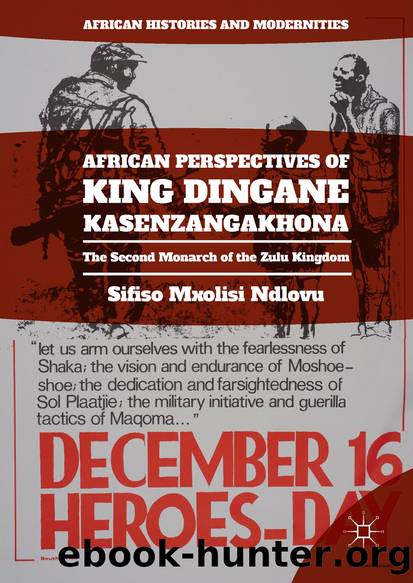
Author:Sifiso Mxolisi Ndlovu
Language: eng
Format: epub
Publisher: Springer International Publishing, Cham
On 16 December 1930, a large contingent of policemen barred the way to the city centre and when demonstrators bore down on them, the police attacked them with clubs and assegais. The results were calamitousâNkosi and three other Africans were stabbed to death and horribly mutilated by the police. Various reports of this incident appeared in the major newspapers including the Durban-based Natal Mercury. 58
The newspaper report highlighted the fact that âabout 70 European constables and 50 Native constables, armed with pick handles and kierries rushed in among the Natives. The yelling rose to tumult, and for some time there was resistance to the police attempts to clear the Flatsâ. After the confrontation with unarmed African workers, âthen began the general flight ⦠Johannes Nkosi was found unconscious. He had been a prominent speaker throughout the day, and had received the passes which were burntâ. To underline the oppressive nature of white-ruled South Africa, the Natal Mercury, as apologists of police brutality, reduced the killing of Nkosi to an act of writing a pamphlet and also claimed he was guilty of being a member of the CPSA. Readers were informed that âit is understood that he [Nkosi] was the author of a pamphlet predicting âHell on Dingaanâs Dayââ, and had been called before the chief magistrate, a Mr Maynard Page. He was described as an organiser of the âDurban Branch of the Communist Party of South Africa â. 59
Other angles and biases emerge from another report in the Natal Mercury which used the language of security police and Pirow, the Minister of Justice, by referring to the African workers as âagitatorsâ. The article reported that by â8.30am there was a crowd of about 160 listening to two agitators, who exhorted them to burn their passes, as a âChristmas boxâ to the Governmentâ. To compound matters further for the white journalist who covered the pass-burning campaign, African workers displayed a communist flagâsurely not a crimeâinscribed with the words: âDown with Pirowâs slave laws. Away with the passes on Dingaanâs Day. Shisani ama passi (Burn your passes)â. 60
The racist white journalists who recorded the event were not concerned about the brutal behaviour of the police and the killing of Nkosi and the two workers. To show their opposition to the counter-commemoration of 16 December, they described the African workers in animalistic terms, as dogs (of the âbobtail orderâ). One such report read: ââ¦from that time onwards a steady stream of Natives came to the meeting and they were immediately button-holed by a bearded Native, wearing a fez and a flowing red robe, who endeavoured to get their passes from them ⦠the Natives present were mostly of the rag and bobtail order⦠extremist agitatorsâ. 61
The report continued ââ¦there were very few kitchen boys and town workers present. It appeared that the ICU order to its members to boycott the pass burning was respectedâ. But to his chagrin, the racist journalist who was an âexpertâ in identifying African âkitchen boysâ and âtown workersâ,
Download
This site does not store any files on its server. We only index and link to content provided by other sites. Please contact the content providers to delete copyright contents if any and email us, we'll remove relevant links or contents immediately.
| Africa | Americas |
| Arctic & Antarctica | Asia |
| Australia & Oceania | Europe |
| Middle East | Russia |
| United States | World |
| Ancient Civilizations | Military |
| Historical Study & Educational Resources |
The Dawn of Everything by David Graeber & David Wengrow(1707)
The Bomber Mafia by Malcolm Gladwell(1625)
Facing the Mountain by Daniel James Brown(1553)
Submerged Prehistory by Benjamin Jonathan; & Clive Bonsall & Catriona Pickard & Anders Fischer(1455)
Wandering in Strange Lands by Morgan Jerkins(1430)
Tip Top by Bill James(1416)
Driving While Brown: Sheriff Joe Arpaio Versus the Latino Resistance by Terry Greene Sterling & Jude Joffe-Block(1376)
Red Roulette : An Insider's Story of Wealth, Power, Corruption, and Vengeance in Today's China (9781982156176) by Shum Desmond(1359)
Evil Geniuses: The Unmaking of America: A Recent History by Kurt Andersen(1354)
The Way of Fire and Ice: The Living Tradition of Norse Paganism by Ryan Smith(1336)
American Kompromat by Craig Unger(1315)
F*cking History by The Captain(1304)
It Was All a Lie by Stuart Stevens;(1300)
American Dreams by Unknown(1286)
Treasure Islands: Tax Havens and the Men who Stole the World by Nicholas Shaxson(1274)
Evil Geniuses by Kurt Andersen(1257)
White House Inc. by Dan Alexander(1212)
The First Conspiracy by Brad Meltzer & Josh Mensch(1174)
The Fifteen Biggest Lies about the Economy: And Everything Else the Right Doesn't Want You to Know about Taxes, Jobs, and Corporate America by Joshua Holland(1126)
